Search Results for: free use

On strip clubs
A lot of shit is spoken about strip clubs. Wherever someone gets their kit off for money you can guarantee that loudmouthed cunts like me will be ready to chip in with an ill-thought-out opinion or jerk a knee or two. Strip clubs are either Good Things or Bad Things, and there seems to be little room for fence-sitting or nuance or grey areas.
As such it is ripe and fertile ground for journalists and anonymous John Does who want to knock out quick opinion-type pieces on ‘My Real Life Strip Club Experience.’
In the New Statesman today an anonymous John Doe explains why he used to go to strip clubs and what he thinks about them. The problem I have with this article is that although it’s quite an interesting piece if seen as an opinion among many (essentially what it is), as a definitive guide to all things stripping (what it pretends to be) it’s a massive pile of wank.
I am by no means a strip club expert, but neither is John Doe. He’s just a man who happens to have been to strip clubs on a number of occasions. As a girl who has been to strip clubs on a number of occasions, I feel compelled to point out that his experiences are not definitive.
Strip clubs aren’t all expensive
Our John Doe sets out just how much strip clubs cost.
“You pay an entry fee of £20. Then you’re shown to a table and you order drinks, which cost at least £5 each. You might not have even seen a nipple, and already you’re £25 down.”
This is probably true of the strip club that he used to frequent. It is not, however, true of all clubs in which women remove their tops.
My favourite club, run by the grumpiest and yet most generous landlord in the whole of East London, charges £3 entry. You walk in, go up to the bar, and buy a pint for about £4. To those in the North who might already be reeling in horror I can assure you that, in London, that’s a reasonably priced pint.
If it’s nipples you’re after, all you need do is wait for the girls to walk around holding out pint glasses full of coinage. You put a pound in the pint glass, then when they have collected a pound from everyone, they get up on stage and whip off their bra. Also, usually (and this came as a surprise to me the first time I went) their pants. By my reckoning that’s £8 for two nipples and a cunt.
Strippers don’t all either love it or hate it
Doe tries to tell us that, far from hating their jobs, strippers (and again, he at no point asserts that he is only talking about the very few that he happens to have seen):
“clearly enjoy the process of performance, grinning at the punters and showing off all sorts of gyratory tricks. “
Do they ‘clearly’ enjoy it? Really? To be honest I’m not sure I’m in a position to judge. I wouldn’t go there if I thought any of them were being forced to do it against their will, but I’m not convinced that every single stripper ‘actively enjoys it.’ After all, if I have to chair a meeting at work I will often grin at the attendees and show off all of my managerial tricks, but that doesn’t mean that on the inside I’m not wishing I was at home eating cheese sandwiches and watching the iPlayer.
Clearly some strippers do enjoy it. Some don’t. Some are having an off-day. Some are thinking about whether they can knock off a bit early because they’ve recorded a really good programme and want to watch it before they go to bed. Grinning at you shouldn’t be seen as definitive evidence of their enjoyment any more than my saying ‘pleased to meet you’ is definitive evidence that I am actually pleased to meet you.
The girls aren’t all on drinks commission
“After a while, you’ll be approached by a girl. She’ll ask how you’re getting on, and pull up a seat alongside you. Then you talk. She might ask you to buy her a drink (champagne: she’ll get commission on this). Eventually she’ll ask you if you want a lapdance – either where you are, for £20, or behind a curtain, for £40. “
Again, this depends on the club. In my experience girls rarely approach me (as a fellow girl, I suspect they think that I have my own tits to look at so probably wouldn’t pay a premium to look at theirs) but even when they do approach, or speak to the guys I’m with, they don’t pressure you to buy drinks. They’re not always on commission – most places I’ve been to are arranged so that the girls get the money for their dances and the bar keeps the bar profits and entry fee. And, for the record, a dance in this particular establishment is a tenner. A tenner. For £40 I’d expect the Royal National Ballet.
Strip clubs are erotic, but not for everyone
The next part is my favourite, so please read/listen closely. Doe explains how, despite having semi-naked or completely naked women gyrating in one’s face, it is not, in fact, an erotic experience:
“It’s not unpleasant, not at all – but we know it only gives the impression of eroticism – how erotic, really, can a human being waving her genitals in your face be?”
The answer, in case it wasn’t sledgehammer obvious, is that it can be incredibly erotic. Cards on the table: the reason I go to strip clubs is because the men in them seem to be having a good time. Lovely though tits are, I’m not actually paying the entry fee just to stare at them. I’m paying the entry fee because there’s something deeply sexy about watching men get aroused – watching men try to drink a pint and chat with their mates whilst sneaking glimpses of the tits jiggling no more than six feet away from their face. Sure, sometimes the clubs ooze skeeze or awkwardness, but there will also be a hell of a lot of sexual tension – at least a few guys trying to sit in a way that doesn’t show their semi through their jeans.
However, rather obviously, that’s not to say that everyone finds it arousing. I know men who are deeply uncomfortable about the whole idea and wouldn’t walk into a strip club even if you promised there was a free buffet inside. I know men who are aroused by the idea but in practice are terrified. I once bought a lapdance for a friend of mine, thinking it’d be a nice gesture. He left the back room after a minute, and emerged white-faced as if instead of shaking her ass at him, the stripper had smashed his kneecaps then handed him a credit card bill.
So, I agree that it’s not everyone’s idea of an erotic night out, but surely we can all agree that it is erotic for some people, yeah?
Not all feminists hate stripping
The final howler, of course, is the one that’s much trickier to deal with:
“Feminists say we should ban the clubs.”
Do they? What, all of them? Because as far as I’m aware there’s actually quite a lively debate on this issue amongst feminists. There are very good arguments for and against, and I don’t think it’s a topic that has yet been settled.
Reasons for banning: they’re exploitative, they can suck in vulnerable women, they perpetrate the view that women want money and men want to see tits, etc. Reasons against banning: because who the hell are we to tell women whether they’re allowed to earn a few quid by getting their tits out, and banning things should generally be a very well justified last resort.
So there you go – muddy waters, which you’re not going to un-muddy just by writing an article about your own strip club experiences in which you imply that everything you say is the definitive truth and everyone else is disgustingly and embarrassingly wrong. The only thing you’re going to do is add another anecdote to demonstrate just how muddy those waters are.
On Prince Harry, Kate Middleton and Tulisa
Somewhere in the world there exists a blurry night-shot video of me sucking a guy’s dick. Don’t hit google, you’ll never find it. The guy who filmed it, whose dick starred in it, is not an arsehole. I’ve had odd moments of panic when I wonder if his computer ever got stolen, or if the tape from the camera was mislaid and picked up later by a curious friend, but I know with utter conviction that he’d never have deliberately shown it to anyone without my consent.
Kate Middleton’s tits
This week some tawdry celeb mags have published pictures of Kate Middleton sunbathing topless.
The pictures (for I have seen them – they are on the internet) are nothing special. They are exactly what you’d expect them to be. They are not newsworthy, or shocking – they’re unnecessary, and the taking of them was hurtful and intrusive and offensive. The buying of them equally so.
And yet I looked. I looked because I was curious. Everyone’s talking about these pictures. I wanted to confirm my suspicions that the fuss was about nothing, and that publishing them was something I could easily condemn.
“Oh, how awful. They invaded this poor woman’s privacy for nothing. How disgusting they are. I’m so horrified I’ll shut this web page in a minute.”
I fucking disgust myself.
Because so rarely in life do I do things that I think are genuinely wrong. I’m happy batting away the judgment of other people when they call me a pervert or a slut, because I have the moral high ground. I usually have enough ethical awareness to avoid doing the things that – although tempting – are actually morally wrong.
And yet I looked at Kate Middleton’s tits.
Prince Harry’s bollocks
A similar dilemma arose during the recent ‘Prince Harry gets naked in Vegas’ shock. It turns out that a young, attractive man got naked in his hotel room with some people.
The resulting storm that brewed was both disgusting and weird. While Clarence House played whack-a-mole with the images that had popped up online, individuals were loudly asserting their right to see the pictures. “It’s a public interest issue,” they said “We pay for him,” they continued. And then, flailing vaguely around the issue of just why, exactly, someone they pay for should be compelled to let you see his bollocks they added “it’s a security issue.”
Well, no. It’s not, is it? Perhaps there are security issues associated with what happened, but the pictures themselves are not a security issue. No one is more or less likely to assassinate Harry on the basis that there is photographic evidence that he has testicles. The fact that the pictures were taken might form the basis of a story about security surrounding the prince, but the actual pictures themselves add nothing to that debate.
Nevertheless, a debate was had. Justifications were made, counterarguments swept under the table, and the prince’s own assertion that – you know – he’d rather we didn’t all cop a look at him in the nude went unheeded. The Sun knocked the whole thing out of the park with a grand announcement that it would publish the pictures because it was the ‘right thing’ to do.
Hooray for press freedom! Hooray for the Sun! Hooray for them posting naked pictures of someone without his consent! What larks, eh? Who wouldn’t shell out 20-odd pence to have a quick glimpse of the prince’s privates?
Well, I guess nice people. People nicer than me.
I’m going to put aside the spurious debate about press freedom for a moment and talk about ethics. Because hey – I’m not a fan of banning people from doing things if at all possible. If I were ruler of the world, I wouldn’t want to have to issue a diktat saying ‘newspapers cannot print pictures of members of the Royal Family in the nude.’
So let’s instead talk in more general terms: is there ever a compelling reason for a national newspaper to publish naked pictures or videos of someone without their consent?
I don’t think there is. Moreover, I don’t think there’s an honest justification for anyone to publish naked pictures of someone without their consent.
Tulisa’s blow job
A few months ago a video was released of FHM’s sexiest woman – Tulisa – giving an ex-boyfriend a blow job. Blogs were ringing with the sound of gleeful dudes rubbing one out, frowning moralists calling Tulisa ‘loose’, and bitchy women criticising her blow-job technique. Someone suggested to me that I jump on the bandwagon, grab myself some cheap SEO traffic, and review the video.
As you can probably tell, I didn’t. The idea of pointing and laughing at someone doing something that they clearly believed was private gives me the shivers. With the certainty that comes from knowing I never want my blurry night-shot blow job video to go online, I know that posting sexual pictures of someone without their consent is unethical and wrong.
Whatever you think of some of the more controversial things I’ve written, I have very strong views on consent, and ultimately I don’t want to be part of anything that tramples all over it. So even if you’re saying that Tulisa’s sexy, Kate’s an English Rose, even if you’re saluting Prince Harry and calling him a ‘top lad’ for playing naked games in his hotel room, the fact remains that he’s made it pretty clear he doesn’t want those pictures published. So we shouldn’t publish them.
But I looked
Here’s the tricky part. How do we ethically justify the fact that, although we’re disgusted by the idea of releasing hot blow job videos, or tit shots, or blurry mobile-phone snaps of a prince frolicking in a hotel room, some of us are happy to watch those things when they appear? The answer is we don’t – we can’t. There’s no need for me ever to see this stuff – it will add nothing of value to my life.
The people who publish this shit are hideous. The people who either take photos without consent or release photos without consent are doubly hideous. But if we’re completely honest with ourselves we’re not much better.
No matter what our reasons for looking, we are still disgusting. What makes me angry is that not only do these situations demonstrate how pathetic I am as an individual, but how pathetic we are as a species. We cannot bear to admit that we googled the pictures out of cheap curiosity or lust. Instead we cite press freedom, security concerns, or the hazards of celebrity.
But the very fact that we want an excuse shows we know deep down that seeking out these pictures might not be our most glorious moment – that we’re crossing a moral line. So let’s drop the excuses altogether, shall we? We can admit that we want to look whilst trying to avoid looking, and while this internal battle rages we can stop lying to ourselves and everyone else.
Let’s not invent bullshit excuses to try and wriggle out of guilt. Accept the guilt. You’re not looking at Prince Harry’s bollocks because you’re a freedom fighter. You’re looking because you’re disgusting. We’re disgusting.
I am disgusting.
On kissing girls
I kissed a girl, and I liked it.
Or more truthfully: I kissed a girl and it was sort of OK but the main reason I kissed her is because there was a dude that we both fancied who we knew would be pretty aroused by the whole scenario.
It’s not quite as catchy, but it is something that happens a fair bit. Ever since I first saw girls kiss in nightclubs I’ve heard whispers about ‘lipstick lesbians’ – usually accompanied by judgmental frowning. I’ve heard people moan about it and damn these girls. They’re stupid, they’re pathetic, they’re attention-grabbing and – perhaps most damning of all – they’re not even really into it. How dare they?
I read an article today by Julie Birchill, in which she discusses these girl-on-girl kisses. Girls who like girls for boys, girls who like girls for attention, and – her example being the famous Madonna/Britney snog – girls who like girls for money.
Sometimes I kiss girls for boys
I’m going to go out on a limb and say that there’s nothing wrong in principle with people pulling others for the arousal of a third party. After all, many fantastic threesomes have begun that way. Some of my fantastic threesomes have begun that way. And I’d be a miserable hypocrite if I didn’t admit that two boys kissing to try and turn me on would… well… turn me on. Finally I suppose I should also admit that kissing girls to give boys erections is something that I do quite frequently – it is, perhaps, one of the tamest things I have done in my unending quest to give guys erections.
Likewise, people do shit for money all the time. Money is not an illegitimate reason to do something – it’s the reason most of us haul ourselves out of bed at godforsaken hours of the morning five days a week to go and do boring things when, given the choice, we’d rather be at home eating crisps and wanking. If you’re a pop starlet who thinks she’ll make more money by kissing a girl, I can see you making a legitimate choice to kiss a girl rather than – say – do something headline-grabbing for charity or get strategically semi-naked in your next music video.
Finally – attention. We all want attention, don’t we? Short of hermits, nuns and wanted criminals, everyone likes having a few pairs of eyes on them. If we burned people at the stake for attention-grabbing, they’d come for the bloggers first but the rest of humanity wouldn’t be far behind.
We’re all just people, making decisions. And the decision to place your tongue inside someone’s mouth and move it around a bit can, like any other decision in our lives, be made because we want money, attention or sex. There’s nothing obviously crass about doing something for these reasons, and yet girls who kiss girls are often met with contempt because they dared to do something that wasn’t purely motivated by a desire for the kiss itself.
The ethics of snogging someone you don’t really fancy
I suspect what people hate most about girls pulling other girls in clubs – and why ‘lipstick lesbian’ is (in my albeit limited experience) a phrase frequently spat with disgust and horror – is the lies. No reasonable person could have a problem with two women who fancy each other pulling in a nightclub – the problem people seem to have with this scenario is that there isn’t always desire. We’re used to kissed being motivated by this, so any other motivation both looks and feels like a lie.
People aren’t angry about what your motivations are (money, attention, or arousing other people), they’re angry because of what they’re not. You’re not motivated by lust, therefore you’re lying.
But my issue with this is that although I hate lies as much as the next person, I don’t feel like this really is a lie – it’s a game. You’re play-acting like you fancy someone in the same way as you might play-act a naughty schoolgirl, or an angry sargeant major, or a runaway My Little Pony. There’s nothing wrong with games as long as all participants know the rules.
The only time this falls down is if one of the participants doesn’t know the rules. If I pull you because we both fancy a guy and want to watch him get an erection in the pub, and if that guy knows that we’re doing that for him, then a good time will be had by all. But if one person doesn’t have that knowledge, and thinks the kiss is the start of something beautiful, then their legitimate and honest desire has been turned into something tawdry and crass.
Imagine someone you’d fancied for years finally getting up the courage to ask you for a snog, which you gleefully do, only to find out straight afterwards that they were doing it on a nudge and a wink from their partner. Horrible, heartbreaking, cruel, and immoral.
That’s what we should be disgusted by. Not the kiss itself, but the way it’s done. Kissing is, like all sex acts, intrinsically dependent on the enthusiasm of the other parties involved.
The person who is kissing you out of genuine love or lust has the right to be offended and upset if you’re being dishonest, and knowingly misleading them, but the people who scowl and whisper ‘lipstick lesbian’ have no such rights. They can guess at your motivations, but they can’t know what rules you’ve established with the other people involved. All they will ever see is two girls kissing – it’s up to those girls to decide whether they’re happy with that.
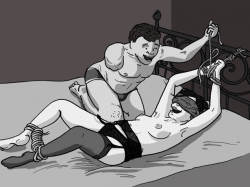
On being restrained: what’s hot about being tied up
I’m an impatient person. I don’t want you to try to fuck me – to tease me gently and have me panting and gasping. I want you to put your dick inside me. I want you to push it into my cunt before you’ve barely got my knickers down. To a certain extent, I want you to act like you don’t care how I want it. That’s one of the reasons I love being tied up… (more…)
How To Blog Anonymously (and how not to)
The following is a blogpost by Brooke Magnanti, who was asked to remove it after a DMCA claim. No, I have no idea why either. She’s asking people to repost it to keep the content live, and because it’s a bloody useful bit of content, I am. You should also read the rest of her blog, because it’s interesting, often angry, and always well worth a read.
Further to yesterday’s post, this is a list of thoughts prompted by a request from Linkmachinego on the topic of being an anonymous writer and blogger. Maybe not exactly a how-to (since the outcome is not guaranteed) as a post on things I did, things I should have done, and things I learned.
It’s not up to me to decide if you “deserve” to be anonymous. My feeling is, if you’re starting out as a writer and do not yet feel comfortable writing under your own name, that is your business and not mine. I also think sex workers should consider starting from a position of anonymity and decide later if they want to be out, please don’t be naive. Statistics I made up right now show 99 out of 100 people who claim ‘if you have nothing to hide you have nothing to fear’ are talking out of their arses.
The items in the list fall into three general categories: internet-based, legal and real-world tips, and interpersonal. Many straddle more than one of these categories. All three are important.
This is written for a general audience because most people who blog now do not have extensive technical knowledge, they just want to write and be read. That’s a good thing by the way. If you already know all of this, then great, but many people won’t. Don’t be sneery about their lack of prior knowledge. Bringing everyone up to speed on the technology is not the goal: clear steps you can use to help protect your identity from being discovered are.
Disclaimer: I’m no longer anonymous so these steps are clearly not airtight. Also there are other sources of information on the Web, some of which are more comprehensive and more current than my advice. I accept no responsibility for any outcome of following this advice. Please don’t use it to do illegal or highly sensitive things. Also please don’t use pseudonyms to be a dick.
This is also a work in progress. As I remember things or particular details, I’ll amend this post. If you have suggestions of things that should be added, let me know.
1. Don’t use Gmail, Yahoo, Hotmail et al. for your mail.
You will need an email address to do things like register for blog accounts, Facebook, Twitter, and more. This email will have to be something entirely separate from your “real” email addresses. There are a lot of free options out there, but be aware that sending an email from many of them also sends information in the headers that could help identify you.
When I started blogging, I set up an email address for the blog with Hotmail. Don’t do this. Someone quickly pointed out the headers revealed where I worked (a very large place with lots of people and even more computers, but still more information than I was comfortable with). They suggested I useHushmail instead, which I still use. Hushmail has a free option (though the inbox allocation is modest), strips out headers, and worked for me.
A caveat with this: if you are, say, a sex worker working in a place where that is not legal and using Hushmail, you could be vulnerable to them handing over your details to a third party investigating crimes. If you’re handling information some governments might consider embarrassing or sensitive, same. Google some alternatives: you’re looking for something secure and encrypted.
There are a few common-sense tips you can follow to make it even safer. If you have to bring people you know in real life in on the secret, don’t use this email address for communicating with them even if only about matters related to your secret (and don’t use your existing addresses for that either). Example: I have one address for press and general interactions, one for things related to my accountant and money, and one for communicating with my agent, publisher, and solicitor. I’ve also closed and opened new accounts over the years when it seems “too many” people are getting hold of a particular address. Use different passwords for each, don’t make these passwords related to your personal information, and so on.
I unwisely left the Hotmail address going, and while I did not use it to send mail, I continued to read things that arrived there. That led to this failed attempt by the Sunday Times to out me. It was an easily dodged attempt but something I would have preferred to avoid.
Over the years I have had about two email account changes every year and have changed my mobile number five times (eventually, I just stopped having one). If you change email addresses it’s a good idea to send people you need to stay in contact with a mail from the old and the new address so they know it’s not someone else trying to impersonate you. And to have a password so you know the response is from the right person – a password you did not exchange via an email conversation, of course. Example: you might send an email to your editor from [email protected] and from [email protected] at the same time, and the one from new_address contains Codeword1. They respond with Codeword2, indicating they acknowledge the change.
It sounds silly, but people can and do scam personal info all the time. Often they do so by pretending to be in on a secret so someone reveals something they did not mean to say. Play it safe. It can feel a stupidly cloak-and-dagger at first, but you soon get over it.
You can register internet domains while staying anonymous but I never did. Some people registered domains for me (people I didn’t know in person). This led to a couple of instances of them receiving harassment when the press suspected they were me. In particular Ian Shircore got a bit of unwanted attention this way.
Because all I was ever doing was a straight-up blog, not having a registered domain that I had control over was fine. Your needs may be different. I am not a good source for advice on how to do that. But just in case you might be thinking “who would bother looking there?” read about how faux escort Alexa DiCarlo was unmasked. This is what happens when you don’t cover your tracks.
2. Don’t use a home internet connection, work internet connection, etc.
Email won’t be the only way you might want to communicate with people. You may also want to leave comments on other blogs and so forth. Doing this and other ways of using the Web potentially exposes your IP address, which could be unique and be used to locate you.
Even if you don’t leave comments just visiting a site can leave traces behind. Tim Ireland recently used a simple method to confirm his suspicion of who the “Tabloid Troll” twitter account belonged to. By comparing the IP address of someone who clicked on to a link going to the Bloggerheads site with the IP address of an email Dennis Rice sent, a link was made. If you go to the trouble of not using your own connection, also make sure you’re not using the same connection for different identities just minutes apart. Don’t mix the streams.
The timing of everything as it happened was key to why the papers did not immediately find out who I was. The old blog started in 2003, when most press still had to explain to their audience what a blog actually was. It took a while for people to notice the writing, so the mistakes I made early on (blogging from home and work, using Hotmail) had long been corrected by the time the press became interested.
Today, no writer who aims to stay anonymous should ever assume a grace period like that. It also helped that once the press did become interested, they were so convinced not only that Belle was not really a hooker but also that she was one of their own – a previously published author or even journalist – that they never looked in the right place. If they’d just gone to a London blogmeet and asked a few questions about who had pissed off a lot of people and was fairly promiscuous, they’d have had a plausible shortlist in minutes.
After I moved from Kilburn to Putney, I was no longer using a home internet connection – something I should have done right from the beginning. I started to use internet cafes for posting and other activities as Belle. This offers some security… but be wary of using these places too often if there is a reason to think someone is actively looking for you. It’s not perfect.
Also be wary if you are using a laptop or other machine provided by your workplace, or use your own laptop to log in to work servers (“work remotely”). I’ve not been in that situation and am not in any way an expert on VPNs, but you may want to start reading about it here and do some googling for starters. As a general principle, it’s probably wise not to do anything on a work laptop that could get you fired, and don’t do anything that could get you fired while also connected to work remotely on your own machine.
3. There is software available that can mask your IP address. There are helpful add-ons that can block tracking software.
I didn’t use this when I was anonymous, but if I was starting as an anonymous blogger now, I woulddownload Tor and browse the Web and check email through their tools.
If you do use Tor or other software to mask your IP address, don’t then go on tweeting about where your IP address is coming from today! I’ve seen people do this. Discretion fail.
I also use Ghostery now to block certain tracking scripts from web pages. You will want to look into something similar. Also useful are Adblocker, pop-up blockers, things like that. They are simple to download and use and you might like to use them anyway even if you’re not an anonymous blogger. A lot of sites track your movements and you clearly don’t want that.
4. Take the usual at-home precautions.
Is your computer password-protected with a password only you know? Do you clear your browser history regularly? Use different passwords for different accounts? Threats to anonymity can come from people close to you. Log out of your blog and email accounts when you’re finished using them, every time. Have a secure and remote backup of your writing. Buy a shredder and use it. Standard stuff.
Sometimes the files you send can reveal things about yourself, your computer, and so on. When sending manuscripts to my agent and editor, they were usually sent chapter by chapter as flat text files – not Word documents – with identifying data stripped. The usual method I used to get things to them was to upload to a free service that didn’t require a login, such as Sendspace. When writing articles for magaznes and papers, the text was typically appended straight into the body of the email, again avoiding attachments with potentially identifying information. This can be a little irritating… having to archive your writing separately, not altogether convenient to work on. But for the way I worked, usually not sharing content with editors until it was close to the final draft, it was fine.
When exchanging emails with my agent and editor, we never talked about actual meeting times and locations and threw a few decoy statements in, just in case. Since it has been recently revealed thatTimes journalists were trying to hack bloggers’ email addresses after all, in retrospect, this seems to have been a good thing.
Another thing I would do is install a keystroke logger on your own machine. By doing this I found out in 2004 that someone close to me was spying on me when they were left alone with my computer. In retrospect what I did about it was not the right approach. See also item 7.
5. Be careful what you post.
Are you posting photos? Exif data can tell people, among other things, where and when a picture was taken, what it was taken with, and more. I never had call to use it because I never posted photos or sound, but am told there are loads of tools that can wipe this Exif data from your pictures (here’s one).
The content of what you post can be a giveaway as well. Are you linking to people you know in real life? Are you making in-jokes or references to things only a small group of people will know about? Don’t do that.
If possible, cover your tracks. Do you have a previous blog under a known name? Are you a contributor to forums where your preferred content and writing style are well-known? Can you edit or delete these things? Good, do that.
Personally, I did not delete everything. Partly this was because the world of British weblogging was so small at the time – a few hundred popular users, maybe a couple thousand people blogging tops? – that I thought the sudden disappearance of my old blog coinciding with the appearance of an unrelated new one might be too much of a coincidence. But I did let the old site go quiet for a bit before deleting it, and edited archived entries.
Keep in mind however that The Wayback Machine means everything you have written on the web that has been indexed still exists. And it’s searchable. Someone who already has half an idea where to start looking for you won’t have too much trouble finding your writing history. (UPDATE: someone alerted me that it’s possible to get your own sites off Wayback by altering the robots.txt file – and even prevent them appearing there in the first place – and to make a formal request for removal using reasons listed here. This does not seem to apply to sites you personally have no control over unless copyright issues are involved.) If you can put one more step between them and you… do it.
6. Resist temptation to let too many people in.
If your writing goes well, people may want to meet you. They could want to buy you drinks, give you free tickets to an opening. Don’t say yes. While most people are honest in their intentions, some are not. And even the ones who are may not have taken the security you have to keep your details safe. Remember, no one is as interested in protecting your anonymity as you will be.
Friends and family were almost all unaware of my secret – both the sex work and the writing. Even my best friend (A4 from the books) didn’t know.
I met very few people “as” Belle. There were some who had to meet me: agent, accountant, editor. I never went to the Orion offices until after my identity became known. I met Billie Piper, Lucy Prebble, and a couple of writers during the pre-production of Secret Diary at someone’s house, but met almost no one else involved with the show. Paul Duane and Avril MacRory met me and were absolutely discreet. I went to the agent’s office a few times but never made an appointment as Belle or in my real name. Most of the staff there had no idea who I was. Of these people who did meet me almost none knew my real name, where I lived, where I was from, my occupation. Only one (the accountant) knew all of that – explained below under point 9. And if I could have gotten away with him never seeing a copy of my passport, I damn well would have done.
The idea was that if people don’t know anything they can’t inadvertently give it away. I know that all of the people listed above were absolutely trustworthy. I still didn’t tell them anything a journalist would have considered useful.
When I started blogging someone once commented that my blog was a “missed opportunity” because it didn’t link to an agency website or any way of booking my services. Well, duh. I didn’t want clients to meet me through the blog! If you are a sex worker who wants to preserve a level of pseudonymity and link your public profile to your work, Amanda Brooks has the advice you need. Not me.
Other sources like JJ Luna write about how to do things like get and use credit cards not tied to your name and address. I’ve heard Entropay offer ‘virtual’ credit cards that are not tied to your credit history, although they can’t be used with any system that requires address verification. This could be useful even for people who are not involved in sex work.
Resisting temptation sometimes means turning down something you’d really like to do. The short-term gain of giving up details for a writing prize or some immediate work may not be worth the long-term loss of privacy. I heard about one formerly anonymous blogger who was outed after giving their full name and address to a journalist who asked for it when they entered a competition. File under: how not to stay anonymous.
7. Trust your intuition.
I have to be careful what I say here. In short, my identity became known to a tabloid paper and someone whom I had good reason not to trust (see item 4) gave them a lot of information about me.
When your intuition tells you not to trust someone, LISTEN TO IT. The best security in the world fails if someone props open a door, leaves a letter on the table, or mentally overrides the concern that someone who betrayed you before could do so again. People you don’t trust should be ejected from your life firmly and without compromise. A “let them down easy” approach only prolongs any revenge they might carry out and probably makes it worse. The irony is that as a call girl I relied on intuition and having strong personal boundaries all the time… but failed to carry that ability over into my private life. If there is one thing in my life I regret, the failure to act on my intuition is it.
As an aside if you have not read The Gift of Fear already, get it and read it.
See also point 9: if and when you need people to help you keep the secret don’t make it people already involved in your private life. Relationships can cloud good judgement in business decisions.
There is a very droll saying “Two people can keep a secret if one of them is dead.” It’s not wrong. I know, I know. Paranoid. Hard not to be when journos a few years later are digging through the rubbish of folks who met you exactly once when you were sixteen. Them’s the breaks.
8. Consider the consequences of success.
If you find yourself being offered book deals or similar, think it through. Simply by publishing anonymously you will become a target. Some people assume all anonymous writers “want” to be found, and the media in particular will jump through some very interesting hurdles to “prove” anything they write about you is in the public interest.
In particular, if you are a sex worker, and especially if you are a sex worker who is visible/bookable through your site, please give careful consideration to moving out of that sphere. Even where sex for money is legal it is still a very stigmatised activity. There are a number of people who do not seem to have realised this, and the loss of a career when they left the “sex-pos” bubble was probably something of a shock. I’m not saying don’t do it – but please think long and hard about the potential this has to change your life and whether you are fully prepared to be identified this way forever. For every Diablo Cody there are probably dozens of Melissa Petros. For every Melissa Petro there are probably hundreds more people with a sex industry past who get quietly fired and we don’t ever hear from them.
If I knew going in to the first book deal what would happen, I probably would have said no. I’m glad I didn’t by the way – but realistically, my life was stressful enough at that point and I did not fully understand what publishing would add to that. Not many bloggers had mainstream books at that point (arguably none in the UK) so I didn’t have anyone else’s experience to rely on. I really had no idea about what was going to happen. The things people wrote about me then were mainly untrue and usually horrendous. Not a lot has changed even now. I’d be lying if I said that didn’t have an emotional effect.
Writing anonymously and being outed has happened often enough that people going into it should consider the consequences. I’m not saying don’t do it if you risk something, but be honest with yourself about the worst possible outcome and whether you would be okay with that.
9. Enlist professional help to get paid and sign contracts.
Having decided to write a book, I needed an agent. The irony of being anonymous was that while I let as few people in on it as possible, at some point I was going to have to take a leap of faith and let in more. Mil Millington emailed me to recommend Patrick Walsh, saying he was one of the few people in London who can be trusted. Mil was right.
Patrick put me on to my accountant (who had experience of clients with, shall we say, unusual sources of income). From there we cooked up a plan so that contracts could be signed without my name ever gracing a piece of paper. Asking someone to keep a secret when there’s a paper trail sounds like it should be possible but rarely is. Don’t kid yourself, there is no such thing as a unbreakable confidentiality agreement. Asking journalists and reviewers to sign one about your book is like waving a red rag to a bull. What we needed was a few buffers between me and the press.
With Patrick and Michael acting as directors, a company was set up – Bizrealm. I was not on the paperwork as a director so my name never went on file with Companies House. Rather, with the others acting as directors, signing necessary paperwork, etc., Patrick held a share in trust for me off of which dividends were drawn and this is how I got paid. I may have got some of these details wrong, by the way – keep in mind, I don’t deal with Bizrealm’s day-to-day at all.
There are drawbacks to doing things this way: you pay for someone’s time, in this case the accountant, to create and administer the company. You can not avoid tax and lots of it. (Granted, drawing dividends is more tax-efficient, but still.) You have to trust a couple of people ABSOLUTELY.I’d underline this a thousand times if I could. Michael for instance is the one person who always knew, and continues to know, everything about my financial and personal affairs. Even Patrick doesn’t know everything.
There are benefits though, as well. Because the money stays mainly in the company and is not paid to me, it gets eked out over time, making tax bills manageable, investment more constant, and keeping me from the temptation to go mad and spend it.
I can’t stress enough that you might trust your friends and family to the ends of the earth, but they should not be the people who do this for you. Firstly, because they can be traced to you (they know you in a non-professional way). Secondly, because this is a very stressful setup and you need the people handling it to be on the ball. As great as friends and family are that is probably not the kind of stress you want to add to your relationship. I have heard far too many stories of sex workers and others being betrayed by ex-partners who knew the details of their business dealings to ever think that’s a good idea.
So how do you know you can trust these people? We’ve all heard stories of musicians and other artists getting ripped off by management, right? All I can say is instinct. It would not have been in Patrick’s interest to grass me, since as my agent he took a portion of my earnings anyway, and therefore had financial as well as personal interest in protecting that. If he betrayed me he would also have suffered a loss of reputation that potentially outweighed any gain. Also, as most people who know him will agree, he’s a really nice and sane human being. Same with Michael.
If this setup sounds weirdly paranoid, let me assure you that journalists absolutely did go to Michael’s office and ask to see the Bizrealm paperwork, and Patrick absolutely did have people going through his bins, trying to infiltrate his office as interns, and so on. Without the protection of being a silent partner in the company those attempts to uncover me might have worked.
I communicate with some writers and would-be writers who do not seem to have agents. If you are serious about writing, and if you are serious about staying anonymous, get an agent. Shop around, follow your instinct, and make sure it’s someone you can trust. Don’t be afraid to dump an agent, lawyer, or anyone else if you don’t trust them utterly. They’re professionals and shouldn’t take it personally.
10. Don’t break the (tax) law.
Journalists being interested in your identity is one thing. What you really don’t want is the police or worse, the tax man, after you. Pay your taxes and try not to break the law if it can be helped. If you’re a sex worker blogging about it, get an accountant who has worked with sex workers before – this is applicable even if you live somewhere sex work is not strictly legal. Remember, Al Capone went down for tax evasion. Don’t be like Al. If you are a non-sex-work blogger who is earning money from clickthroughs and affiliates on your site, declare this income.
In summer 2010 the HMRC started a serious fraud investigation of me. It has been almost two years and is only just wrapping up, with the Revenue finally satisfied that not only did I declare (and possibly overdeclare) my income as a call girl, but that there were no other sources of income hidden from them. They have turned my life and financial history upside down to discover next to nothing new about me. This has been an expensive and tedious process. I can’t even imagine what it would have been like had I not filed the relevant forms, paid the appropriate taxes, and most of all had an accountant to deal with them!
Bottom line, you may be smart – I’m pretty good with numbers myself – but people whose job it is to know about tax law, negotiating contracts, and so on will be better at that than you are. Let them do it. They are worth every penny.
11. Do interviews with care.
Early interviews were all conducted one of two ways: over email (encrypted) or over an IRC chatroom from an anonymising server (I used xs4all). This was not ideal from their point of view, and I had to coach a lot of people in IRC which most of them had never heard of. But again, it’s worth it, since no one in the press will be as interested in protecting your identity as you are. I hope it goes without saying, don’t give out your phone number.
12. Know when les jeux sont faits.
In November 2009 – 6 years after I first started blogging anonymously – my identity was revealed.
As has been documented elsewhere, I had a few heads-ups that something was coming, that it was not going to be nice, and that it was not going to go away. We did what we could to put off the inevitable but it became clear I only had one of two choices: let the Mail on Sunday have first crack at running their sordid little tales, or pre-empt them.
While going to the Sunday Times – the same paper that had forcibly outed Zoe Margolis a few years earlier, tried to get my details through that old Hotmail address, and incorrectly fingered Sarah Champion as me – was perhaps not the most sensitive choice, it was for me the right move. Patrick recommended that we contact an interviewer who had not been a Belle-believer: if things were going to be hard, best get that out of the way up front.
So that is that. It’s a bit odd how quickly things have changed. When I started blogging I little imagined I would be writing books, much less something like this. Being a kind of elder statesman of blogging (or cantankerous old grump if you prefer) is not an entirely comfortable position and one that is still new to me. But it is also interesting to note how little has changed: things that worked in the early 2000s have value today. The field expanded rapidly but the technology has not yet changed all that much.
As before, these ideas do not constitute a foolproof way to protect your identity. All writers – whether writing under their own names or not – should be aware of the risks they may incur by hitting ‘publish’. I hope this post at least goes some way to making people think about how they might be identified, and starts them on a path of taking necessary (and in many cases straightforward) precautions, should they choose to be anonymous.