
Note that this post discusses rape, rape culture and the recent news about Cornell University.
I don’t write about dark shit like I used to. I think in recent years, when rape and sexual assault has come up in the headlines, I’ve been less inclined to write about it than I am to just share other people’s takes before weeping quietly in a corner. Part of me wants to say it’s because it’s too depressing, which it is. But I don’t think that’s the reason. An armchair psychologist might say it’s because I find it triggering, having been raped myself a few years ago. But it’s not that either. I think the main reason I don’t write as frequently about rape these days is because it just feels so fucking futile.
When I was young and idealistic I’d have told you that I’d be happy to change one person’s mind: if I could inspire just one man to call out a friend who made a rape joke, then that would be a blog post worth writing. These days when I sit down to get my thoughts in order about the latest horrific nightmare, I grow increasingly frustrated because I know exactly what will happen next:
Women will share it. Lots of them will. Fewer men will share it, but some will, and I can usually predict exactly which ones. It will be the same men who always share these stories (thank you), but rarely are there new faces on the roster. The new men will pop up in replies to tell me things like ‘I am ashamed of my gender’ or ‘I can’t understand how anyone could do this’, eagerly distancing themselves from the behaviour of those Other Men, the ones whose actions have sparked off the original post.
I’m going to try and write about Cornell today, and I’m pretty sure the exact same thing will happen.
If you aren’t familiar with the story, seven men in a fraternity at Cornell University are alleged to have gang-raped a woman who was drunk, drugged and unable to consent. When she initially reported this to Cornell University Police, the University dealt with the allegations outside the standard criminal justice system – by allowing a panel of faculty to decide on ‘sanctions’ for the rapists. Including expulsion, suspension, and writing essays about their conduct. A lot of focus has been placed on the essay-writing (quite rightly, because what the absolute fuck was anyone thinking?) but I’d argue that expulsion is a horrifyingly weak response to gang rape too.
Jane Doe has now filed civil proceedings and a criminal investigation has been opened (the men deny the allegations), so I’m not going to go into detail but you can read the news in a number of places so feel free to Google it.
There’s one extra thing that it’s important to know when it comes to this story, though: pictures of Jane Doe were shared around a fraternity group chat advertising her as ‘free pussy’. At one point someone texted the group to ask ‘shop still open?’ and was told yes.
There were 57 men in the group chat, at any point one of them could have said ‘this is fucked up’ or ‘stop’ or ‘I’m calling the police’. They didn’t.
What would you do?
Some men reading this will be thinking ‘if I were there in that room, I’d have stopped it.’ And… hmm… maybe. If you happened to be in that room perhaps you’d have made a dramatic gesture to save this woman from the ordeal. But you weren’t there so we’ll never know.
Others will be thinking ‘if I were there in that group chat, I’d have said something.’ And again, maybe. If you happened to be in a group chat with 57 other men in which someone was advertising ‘free pussy’, maybe you’d have said something. But you weren’t in that group chat, so – again – we cannot know.
There are a lot of ‘ifs’ when I talk to men about this kind of thing. If they had been there, if they knew about it, if one of their friends did a similar thing. But you guys are here right now, in a world where rape and sexual assault is regularly normalised, excused, laughed off, dismissed, minimised…
So my question is: what are you doing now?
Being a ‘Good Guy’ takes work
Yesterday I spotted this post on BlueSky by Hannah Vardit:
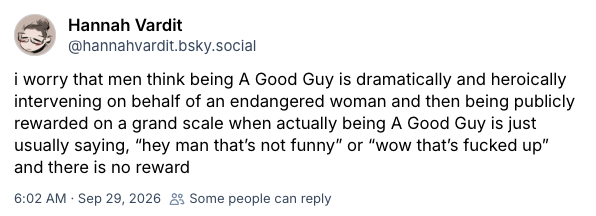
And it is such a neat summation of exactly why women often feel frustrated when these stories hit the headlines. Why so many of us are angry with the men in our lives who are refusing to do the boring daily work to fight rape culture because they’re waiting for the opportunity to be a dramatic hero instead. One that comes neatly gift-wrapped and labelled ‘this is your chance’. A chance which doesn’t come with any risk, only reward.
It is incredibly awkward to fight against rape culture, as it’s awkward to fight against any ingrained cultural norm – awkwardness and shame is one of the ways in which cultural norms are enforced. It is much easier to sit in silence than it is to stand up and say something, because the act of ‘saying something’ marks you out as difficult, and usually means putting yourself in an uncomfortable position outside of the group.
If you wait for someone to attempt rape right in front of you, dreaming about being the big man who steps in to be the saviour, you’re going to be waiting a long time. The actual work that you – an average man who hasn’t joined a frat house because you’re not a douchebag – need to do involves awkward conversations and choices that will make your life harder.
Protecting women from rape doesn’t mean swooping in like Superman to wild applause and a sense of victory, it means starting a conversation that might leave you feeling like shit.
What are you doing right now?
It’s awkward as fuck calling out rape culture. It hurts, and it loses you friends. Saying ‘I don’t want to hang out with that man because he repeatedly makes jokes about sexual assault/treats women like they’re livestock/touches women without their consent’ is hard. Saying it to a crowd of other men who are all laughing along with his antics is even harder. There is no medal for doing it, in fact the ‘prize’ is often that you have to withdraw from spaces you’d otherwise enjoy hanging out in when you speak up and you’re told to stop being difficult. If you genuinely want to help, you have to become difficult.
You know what’s easy? Replying to a woman’s post to say ‘ugh I’m so ashamed of my gender’! Bragging to the nearest woman that you aren’t like those other men, then waiting for her to congratulate you.
Far harder to start an awkward conversation. One-on-one or in the group chat with your guy friends. Somewhere there aren’t any women to show off to. I don’t want men to just share this post then give themselves a pat on the back for helping, I want them to take the conversation to spaces where rape culture is rarely (if ever) discussed.
Take it to your friends who make misogynist jokes, saying: ‘I’m not comfortable with this – you’re normalising the sort of shit that happened at Cornell’.
To the pub when you’re discussing other things in the news, saying: ‘isn’t this Cornell news fucked up?’ and inviting other men you know to condemn it too.
To your colleagues and family members who make coded references to ‘trial by social media’. Take it there, pick up the argument. Fight back. Explain that false allegations are vanishingly rare. That actual rape convictions are incredibly difficult to get. That men are more likely to be raped themselves than be falsely accused of rape. Have the argument. Make things uncomfortable. Be difficult.
I guarantee you’ll get some awkward silences.
And you should do it anyway.
Care when no one’s looking
My despair at this particular problem came into sharp focus around this time two years ago, with the news about Gisèle Pelicot. In the weeks afterwards, and during the trial, women I know were sending links to each other and talking talking talking about how fucked up this story was. How appalled we were, how shocked, how numb.
A friend and I discussed it over coffee, and together we realised that the horror of the story itself was given extra weight by our intense disappointment in the men around us. This French news had spread like wildfire through our women friends across the world, yet at the time not a single man either of us knew had proactively mentioned it.
She told me she’d asked a man she loved about this, out of interest: had he discussed it with any of his friends?
His response: That would be really awkward. Why would I do that?
BECAUSE YOU SHOULD CARE, MOTHERFUCKER. That is what I want to yell at these men. CARE. Because this news is traumatising and consuming so many women in your life that you claim to love, care! Don’t just act like you care when you know our eyes are on your social media timeline, or when you want to show women that you’re on our side. Don’t just perform care in pursuit of ‘good guy’ points because the feminist inspectors might be looking!
Care when we aren’t looking! Get involved! Do the dirty work!
When I got raped, I mentioned it. Not because I wanted sympathy (or because I’m ‘brave’ – blergh – I don’t need cookies) but because at the time it was the most significant thing that had happened in my life. When someone asked me ‘how’s life treating you?’ or ‘what have you been up to lately?’, omitting it from my story felt like embracing a level of shame that I did not feel. I know that if I’d been mugged or burgled – or if that had happened to one of my friends – then talking about that would be completely normal. I didn’t think rape should be different. I mentioned it.
And a significant portion of men did not like that at all. They’d shuffle awkwardly in their seats, eyes downcast not knowing what to say, then try to find a brand new topic as soon as they possibly could. Women would go ‘ah mate fuck I’m sorry that sucks. What a cunt. What happened?’ They’d ask me questions to tease out the story, opening up a bit of space in the conversation to let me talk about it if I want to. Most men didn’t. They don’t want to know, they don’t want to hear it, they want it to go away.
What are you doing right now?
I’ve got great news for the men who want it to go away: you can help. You can. But like the woman in the post above says, you don’t get a medal. You don’t get a parade. You get awkward silences and you lose friends and you become known as the difficult one. As I was the difficult one, mentioning my rape in the month after it happened, as if acknowledging this event was a grubby little faux pas rather than simple honesty about my life.
Women talk about this stuff. Gisèle Pelicot, Cornell, our own experiences. We do it to show others they’re not alone, because we don’t want to let shame bury important truths, and often just because it’s a part of our lives. For us, this is not hypothetical. It happens. It feels harmful and painful and ugly to shroud it in silence.
So it’s deeply upsetting when silence is the primary contribution from men we love. As it’s also upsetting that men who do want to condemn rape and assault so often direct their performative horror at those of us who do not need to hear it. They pop up in my replies on social media to say ‘hey look, I’m a good guy! I think rape is bad! I abhor rapists! I’m on your side!’, waiting for the ‘like’ they’ll receive as reward. And sometimes I scroll down their timeline for a scrap of consistency – a hint that they’d care about this if they weren’t trying to impress me in that moment… and so often it’s silence again.
What are you doing right now?
Ask yourself this question, be honest about the answer and I suspect most of you will realise it’s ‘not enough’. For what it’s worth I think that’s my answer too.
When I was young and idealistic I believed if I could get just one man to call out a friend who made a rape joke, then that would be a blog post worth writing. These days whenever I sit down to write one I get tangled in the worry that nothing I do can ever make a big enough difference, so I end up writing nothing at all. It’s a similar attitude to the one that I’ve criticised above – I’m waiting for the chance to be a hero who changes minds, rather than just accepting that the work needs doing anyway. It is meaningful and necessary, even if it’s only a drop in the ocean. I won’t get a medal or a prize, but I should do it anyway.
So here’s a post about Cornell: what happened was extremely fucked up. Although the vast majority of us will never have the opportunity to intervene and stop an individual being raped, we all live in a society where this shit happens. We’ve all seen and heard conversations in which it is downplayed, normalised, dismissed or laughed off. We all have voices to speak out against it.
There were fifty seven men on the Cornell group chat. Thousands of men will read this blog post. You’re statistically unlikely to ever be invited to a rape party, but you’re very likely to be friends with someone who’d commit rape or sexual assault. You’re almost guaranteed to be friends/family/colleagues with someone who would excuse or downplay it.
This is the world you live in. This is your chance. I’m sorry it doesn’t come with a cape and a cheering audience, but the good news is you can seize it any time.
So what are you doing now? Are you starting conversations? Powering through the awkwardness? Being ‘difficult’ in the face of fucked-up norms? Are you challenging misogynist jokes or the normalisation of sexual violence? Are you supporting and believing the people in your life who tell you their own rape or assault experiences? Are you demanding accountability for perpetrators?
Don’t tell yourself you’re a better guy than the ones in the Cornell group chat: ask yourself what you’re doing to change the world you’re living in right now. Ask these questions, consider your answers, and then – this part is crucial – do not tell me.
I don’t need to see your homework.
There is no medal.
Please do it anyway.