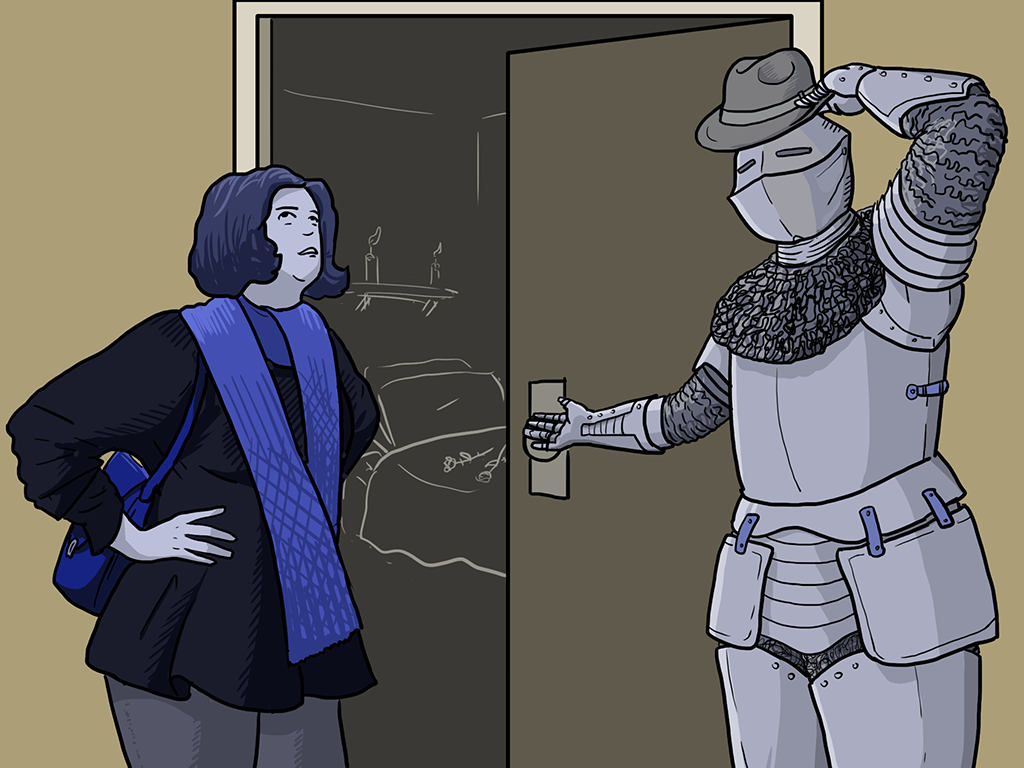
If you could put one thing from the world into ‘Room 101’, banishing it forever from the planet, what would you choose and why? There’s plenty I’d be tempted to go for, I am a person who gets angry about a lot of things: plastic cups, pear cider (it’s NOT FUCKING CIDER), or men on Twitter explaining my own bra to me. And that’s before you even get started on the important bits like war, poverty, and every political ad that’s ever been shown on Facebook. But there’s one particular concept that seems ready to disappear: chivalry. Chivalry is on the way out, and I won’t be sorry to see it go.
I only mention Room 101 because in the most recent episode of the BBC show, Chris Kamara wanted to banish something fairly controversial: men who don’t stand up for women on the tube. And it got me thinking about our notion of ‘chivalry.’
Chris seems like a nice dude. He gets genuinely annoyed by situations in which people who don’t need to sit down end up sitting down, while those who might need a seat have to stand. And I am down with this. It’s polite to offer your seat to someone who may need it more than you: if they’re heavily pregnant, or using a walking stick, or just struggling with the rattling jolts of the Bakerloo line. Chris is a nice bloke. But that’s exactly the problem with ‘chivalry’ – it tricks nice blokes into thinking that sexism is a character strength.
What exactly is ‘chivalry’?
Ask your average person on the street, and they will probably tell you that ‘chivalry’ is about treating women with respect, via the medium of performing small gestures of politeness: opening doors, offering your seat, or walking on the outside of the pavement so that we don’t get our pretty dresses splashed in the wake of a passing omnibus. If you pushed harder, your average person might link chivalry to days of yore when knights would ride around the country saving maidens from terrifying fates, waving big swords around, and then writing tortured poetry in the language of courtly love.
In fact, that idea of chivalry is one that we’ve built over time, and it has very little to do with knights giving respect to women. As Dr Eleanor Janeger, of the blog ‘Going medieval’ explains:
“Basically then chivalry and the chivalric code has fuck all to do with women at all. It’s a bunch of rules about how to conduct yourself if you are a rich dude, with a horse, a lot of weapons, and time on your hands. Saying that you treat women well because of chivalry makes about as much sense as saying you treat them well because of the highway code. It’s just not a thing.”
Read the whole blog post, because it’s ace, and if you want to fall right down the ‘weird shit people used to believe about romance in medieval times’ you should also check out this post on courtly love. The long and the short of it is that our ideas around ‘courtly love’ are based on some fairly terrifying ideas about possession, ownership and deserving-a-shag-just-because-you-relentlessly-pursued-a-woman.
What’s wrong with chivalry?
So our modern understanding of chivalry is not only wrong, it also frames women as meek and fragile, while men are their valiant protectors. And in case you haven’t been paying attention, it turns out that not only are women NOT universally meek and fragile, men might not all be knights in shining armour either. I could bang on in this vein for ages: gender is not the simple binary that we thought it was; women don’t need to be patronised by strangers; often what looks like ‘chivalry’ is actually a come-on in disguise so unsurprisingly quite a few women are suspicious of it for this reason… etc.
But I won’t go too far down that rabbit hole: from a feminist perspective you’ll either already agree with me or be unlikely to be persuaded by anything I can say from this perspective. So let’s switch tack: let’s have a look at why chivalry sucks for men.
Men: abandon your ideas about chivalry
Chivalry makes nice dudes act like dickheads. It tells men that in order to be ‘nice’ to women, you must treat us like we are delicate flowers capable of being crushed at any minute. That’s fundamentally not a nice thing to believe, and it’s why I suspect that ‘opening doors’ and other little politenesses nevertheless cause a bit of cognitive dissonance for the men who do them. I have lost count of the number of times ‘chivalry’ (in this limited, non-medieval sense where it means ‘being polite to women’) has been raised as a potential counterpoint to feminist thinking.
“I thought I was meant to open doors for you, why do you now want to be equal? You can open your own door!”
This argument trips so easily off the tongue because… well, because it’s basically right: women don’t need extra help opening doors purely because of our gender. Because at the heart of this weird concept of chivalry there’s a fairly unequal idea: the idea that women are incapable of performing the same tasks that men are.
That doesn’t mean the men who do it are terrible people, but it does mean that our world would be better off if we let the concept quietly ride off on its warhorse into the sunset.
Chivalry does not equal niceness
There are millions of men who have grown up with the message that ‘chivalry’ is essentially the same as ‘basic human politeness’, so understandably when women like me tell them not to give us their seats on the tube, they’re puzzled and worried. Torn between wanting to be nice and not wanting to offend, they dither and panic like… well, like me when I want to stand up for an older guy but I’m worried he’ll be put out if he realises I thought he looked frail.
If you’ve been taught that something is polite, dropping the habit can be tricky. And it can be hurtful, if you think you’re doing something nice, to be told that actually what you’re doing is a bit patronising. That’s why I don’t reply to men offering me their seat with a scream of rage and a dressing-down: I usually just say ‘no thanks, I’m fine.’ There will be some women who reply by accepting the offer of a seat, and some of them will probably be hacked off that I’m even writing this post. Especially if they’re wearing heels and they’ve been standing up all day.
But by my reckoning, people in heels who’ve been standing up all day can still be offered seats on the tube, it’s just that now you can offer them your seat because they look knackered, rather than because they look feminine. It means that dudes who wear heels/have been on their feet all day/look knackered will get exactly the same treatment.
Offering seats to those who need them: good.
Assuming women will always fall into that category: not good.
You don’t need to stop opening doors, or saying a friendly ‘hello’, or RSVPing politely to dinner party invitations: you just need to drop the idea that these are things you should do on the basis of gender. Who doesn’t want to receive basic courtesy from people they meet? You can hold doors for men too, if they’re walking towards them. You can stand up for older guys on the tube. You can do all the nice things that you’d previously have done under the guise of ‘chivalry’, except that this time you’re doing them because you’re nice, not because you’re sexist.
The ‘S’ word is a bit controversial here purely because of the apparent ‘niceness’ of chivalry: those who practise this modern version of chivalry always do so because they think it’s a nice thing to do. They expect it to be gratefully received. And so when the response is ‘that’s sexist’ they feel hurt and defensive, because in their minds they were doing a good thing.
But you can be nice anyway. To everyone. Regardless of gender. If chivalry is dead, it doesn’t mean all the knights in shining armour are dead too, it just means they’ve been given a different brief: be nice to people because they need it, not because they’re women.
12 Comments
So interesting to read about how the term chivalry originated. I rarely come across men who are chivalrous to be honest, so it must be dying out. I’ve been the heavily pregnant girl stood on the bus whilst people just shoved past me. I think because of that, when it does occur with strangers it makes me uncomfortable.
I completely agree with you, if someone looks like they need your seat, offer it to them. But I don’t need it just because I’m a woman.
Aurora x
exactly my feelings on the subject. I’ve been practising equal-opportunities chivalry for a while now, using actions to gently remind the older-of-fashion that I dont need pretty-flowering, but that being generally polite to everyone is great and yes please to that. Chronic invisible illness would very much like the seat for looking knackered! My favourite move is to cheerfully accept a chap opening the door for me, so that I’m then a pace ahead and able to equally cheerfully open the next one for him. The arched eyebrow along with a jolly ‘no, after You’ gets a sheepish recognition every time.
I live in the US. I don’t speak your English very well and I hope you do better with my ‘dialect’. It has been my observation that over a period of decades the door opening ritual is changing. There is the gender issue, but more and more I see that opening the door is a form of politeness. One person reaching the door at a millisecond before the other will maybe hold the door for the other. This is often between men and I don’t know about how it is with women. I suspect that it is the same. Some subconscious cue determines who holds the door and who says “thanks” and walks through. Perhaps the problem has finally coming down to the ‘door’? It could even be the opening of a dialogue that could help us all in these tenuous times. One can always hope.
Since gender equality is very important to achieve, I open the door for everyone upon receiving that subconscious cue.
I started to add a comment, which then turned into such a length it became a post onmy site!
Author Jim Butcher is quoted to say, “For me chivalry isn’t dead; it’s an involuntary reflex.” To some level I personally agree, as this is how my mind works. What isn’t clear is how he defines chivalry. For me it is about being aware of your surroundings, reacting accordingly and appropriately. For example, I would always stand and offer my seat to an elderly person, male or female, more out of respect than anything else. I open doors for men and women equally especially if I am in a group, or entering a shopping centre, where I might hold a door half open after I have passed through it.
Quite recently I ran for a train with a female colleague in Dubai. In my rush I failed to notice I had entered a ‘pink’ carriage – no men allowed! My error was soon realised and before my colleague could drag me over the line (yes, a line) in to the mixed sex area, (no sex being offered) I turned and apologised to the ladies in the immediate area. In another situation I saw a very healthy young lady standing on London Underground train with one arm above her head holding a safety handle. (Ever since I was a kid I thought they looked phallic!) Anyway, I gave my seat to the young lady as I could see one or two business types getting into her personal space; she accepted, and she knew why I had offered. When I went to leave the train, she touched my arm and said thank you. It makes your day better when you can do something for a stranger or a stranger does something for you.
I am in a D/s relationship and I insist that I open my wife’s car door for her. People see this and comment, and more often it is positive. Am I being chivalrous or just paying special attention that is not run-of-the-mill for most people? I admit it come close to throwing down my coat over a puddle, although I’m not THAT keen!
Being observant and kind by offering seats or holding doors does not make you more of a potential rapist, or disrespectful to women. It makes you half civilised and a contributor, not a leech on society.
Women are just percentage of the gender pool I do things for as a human being to say, ‘I see you and I recognise you!”
Why is it that you’re only comfortable with role play during sex? You’re seemingly happy for a man to treat you like a piece of meat purely there for his pleasure during sex, but not for him to hold the door open or offer you his seat on the train. As if everything outside the bedroom is the ‘real world’ where actions must be taken to their extreme logical conclusion (man offers me his seat, therefore he must think that I am weak and inferior) but everything that occurs in the bedroom (quote: “I am only there for one simple thing: to provide a warm, wet hole for him to fuck”) seemingly has no consequences for how male-female relationships are framed. If you think that a man who is socially conditioned to be chivalrous subconsciously harbours sexist views, why do you not also feel that allowing a man to use you purely as a something to “dump his spunk inside” (another quote from your blog) doesn’t also result in conditioning him to see women as inferior?
“Why is it that you’re only comfortable with role play during sex?”
Because that kind of role play is often hot during sex – with people I have specifically chosen to be with, and who understand and respect my desires.
“You’re seemingly happy for a man to treat you like a piece of meat purely there for his pleasure during sex, but not for him to hold the door open or offer you his seat on the train.”
The former is consensual sex with someone I know, doing activities I like, the latter is a stranger making assumptions about me and on the basis of those assumptions doing things that I don’t like. I genuinely can see no connection between these two things.
“why do you not also feel that allowing a man to use you purely as a something to “dump his spunk inside” (another quote from your blog) doesn’t also result in conditioning him to see women as inferior?”
I don’t ‘allow’ a man to use me, I ask my partner for the kind of sex I like, and we have the kind of sex we like together. It would only result in ‘conditioning him to see women as inferior’ if he – like you – did not understand that I have thoughts and desires and feelings, or if he didn’t listen to those thoughts and desires and feelings.
I think the reason this is so tricky for you to get is you seem to be incapable of understanding that I have an internal life. I don’t ‘allow’ this shit, I desire it. And the men with whom I do it understand that I am a whole human person, capable of consenting to some things in certain contexts, and withdrawing my consent from other things that make me uncomfortable. Saying that I should be happy to be treated like shit by all men because I occasionally enjoy role-playing submission with *specific* men is deeply creepy and fucked up.
I have enjoyed fucking with the concepts of chivalry for ages. I look a lot younger than I am so get a lot of the paternalistic chivalry as flirting/sexual domination men do with younger women despite actually being 40 and often old enough to be their mother. But I also have an invisible disability.
So sometimes I really need that seat or door or help from a cab driver and will take it with a thank you and nothing more. But often I enjoy using my thank you as a way to flirt with them and subvert the dominance aspect.
And quite often I’ll open doors or whatever solely to chat men up. In my younger sluttier single days some of my best flings were men I picked up this way. They thought I was dominating them but it was submission through service because I loved it but couldn’t find other outlets for it.
Plus I just love flirting sexually or platonically. I love those moments of human interaction in a big city. I’ll speak to women too, stand up for girls getting hassle (which chivalry never seems to bother with) and offer seats to older women or other disabled people or make abled people give their seat up if I can’t.
But my favourite is helping elderly men by treating them like a gent and subverting the whole chivalry nonsense to be all ‘oh you wouldn’t insult a woman like me not to take my seat, would you’ with all the flirtiness men accompany chivalry with.
They end up too confused but also so gratified by it that they just obey. A subset of Patriarchy Chicken if you like. Makes TfL so much more fun…
Ok, I’m going to preface this with the statement that in real life I’m an extremely oblivious person, who will do nicenesses for anyone who seems like they’d appreciate it, but will almost never be able to tell that unless given ridiculously clear signs. Yes I care about other people, I’m just bad at social stuff. So the following question is really a hypothetical on my part:
What’s wrong with treating any specific group of people better than the standard? Obviously treating anyone *worse* than the standard is bad, it causes suffering. Obviously treating everyone to “standard” is neither bad nor good, it’s just adequate, that’s the definition of a standard, and it will depend on the times, and what society asks of the people who make it up. But treating someone *better* than the standard? How can that possibly be a bad thing? I don’t mean *thinking* you’re treating them better, or making patronising assumptions about them. Like, for instance, if I were to hold a door open for a woman, and don’t follow that door-holding with any kind of bad behaviour, like many do, then what is really the harm here? No matter what reason I may have in my head for acting as I did, so long as it is something helpful to others, how can it possibly be a bad thing to do? The only way I might imagine to have offended that woman in the example, is if she wanted to get the door open herself for personal reasons. In that case, she might say so and then fine, I apologise, we can run it back and get out of her way, but I even though it is an assumption in strict sense, it doesn’t seem patronising to me that people would generally prefer to avoid that one small hassle every once in a while. I would.
What I’m getting at is, is it possible ever to say that any kind of no-strings-attached kindness is “bad”? Would you think less of someone because they donate to *this* legitimate charity instead of *that* one, for whatever reason, obtuse as it may be?
So basically you’re saying ‘I’m nice and I’ll do things for anyone… but WHAT IF I didn’t?’
My answer to this is… don’t. Don’t swap what you’re doing. Why would you want to?
“What’s wrong with treating any specific group of people better than the standard?”
If you read the article, I explain exactly why chivalry – though it *seems* nice on the surface – does not actually constitute ‘better treatment’. Women are not incapable of opening doors. If you come across someone who looks like they might be – because they’re frail and the door is heavy, because they’re in an electric chair and it’s an awkward reach for them, because they’re carrying a pile of books, whatever – then do that kindness to/for them. I don’t get why this is challenging to understand, or why it requires a debate about edge cases. Just do the nice thing for people who seem like they might need it: don’t assume all women need it, because they don’t.
“Would you think less of someone because they donate to *this* legitimate charity instead of *that* one”
This is a weird straw man, and assumes that women need the ‘charity’ of people opening doors for them. Some might! But not because they’re women! Hope this helps.
And I shan’t swap what I am doing, indeed. With all due respect, you seem to have misunderstood my attitude; it was much more “annoying philosophical abstracting” than “annoying devil’s advocate nitpick”. Though, granted, the “annoying” part is common, so if you won’t reply, or bother to read, or even if you just delete everything I’m saying here, including this particular comment, I won’t much mind; though, if you’re going to ban me from the whole site, at least give me a reason first. With that in mind, let’s get to it:
I did read the article, and I wholeheartedly agree with it. Acting on patronising assumptions about folk is indeed an easy way to blind yourself to the harm in you may be currently doing and the harmful ways in which you might react, when someone will tell you to back off. In a way it can be seen as a kind of back-handed compliment: “I help you, because you need help”. (also, whew, I think we may need a less, um, disconcerting vernacular on some mobility-enhancing tech, because *that’s* not how I pictured an “electric chair”. In all fairness, that may speak more to my own wickedness than anything else, though)
My particular hypothetical, to phrase it better than I did above maybe, might be something like:
Let’s say a woman accidentally drops, oh I don’t know, some loose change maybe? A piece of paper or a thingamajig, something of the sort. Complete accident, happens to the best of us. As that happens, and before she has perhaps even noticed/registered the accident, a guy who was passing about picks it up and hands it her. In a completely normal way mind, not letting any kind of insinuation show. Now at this point the guy has already made some assumptions: “this person probably wants [mystery thing] back”, “this person would prefer not to have to crouch down and pick it up”, “this person probably doesn’t mind a stranger handling [mystery thing] for the absolute minimum amount needed to hand it back to them”, as a bare minimum would have to be assumed. However the guy may be making all kinds of assumptions on top of these ones, some benign, some perhaps insulting, some just plain weird. We simply cannot know from the outside. Now the woman has to react in some way to this, and in doing so, she too may make assumptions: “oh, a well-meaning act”, or “oh, a total bell-end”, perhaps. She could also not make any “significant” assumptions at all in this case. However she has chosen, she will act: a “thanks”, or a “you’re part of the problem”, or letting nothing at all show. The end.
Now all I’m really thinking here, is that in this scenario, whatever the inner rationale of the guy might have been, it seems absurd that we can somehow judge him merely from his actions, one way or another. From the perspective of the woman, it’s impossible to tell anything about why she was treated this way, whether she liked the treatment or not. Had the guy’s act been bad, like if he’d pushed her as she was bending down to pick the item up, or if he’d demanded a kiss in exchange for handing it back (eww), then yeah, we can judge the hell out of that arsehole. The guy may have been thinking “she’s a woman, needs my help”, or not, or he may have even been thinking something completely out of left field. So long as the act isn’t a bad one, and he’s not revealed to be a twat in the following interaction, it seems to me that we couldn’t possibly find a problem here, on his side at least.
You see, I may act nice, but sometimes that niceness is motivated in unusual ways. It may be risky, for me, to have to contain everything that would be a faux pas from letting slip, but, so long as one accepts the responsibility, and, should they fail to uphold it, the consequences; is it really immoral somehow, to live this way?
There are a lot of words in your comment but it seems that broadly what you’re asking is “does it matter if a kind act is done for bad reasons?” – I’m afraid I can only point you here to the history of ethical philosophy for a whole range of answers. There are lots of potential responses to this depending on whether your outlook is based on utilitarianism, virtue ethics, deontology etc etc. Google ‘frameworks for ethical philosophy’ if you’d like to find out more.
My personal take is that if you find yourself regularly doing things for reasons you know are ‘bad’ or that don’t fit with your moral framework, then you should examine your behaviour and try to behave in accordance with that which you believe to be morally good. It sounds like you might have a more utilitarian approach than I do, where the outcome/consequences are the only things that matter, and motivation does not come into it. I have a pretty rights-based approach to ethics. Hence my argument here: chivalry is bad, because if you pursue it as a strategy you end up treating women as if they are lesser beings.
You do then contradict yourself though, by saying “it seems absurd that we can somehow judge him merely from his actions”. So I’m not entirely sure what you’re actually arguing *for* here. You seem to be arguing that we shouldn’t judge people for either their actions *or* their motivations. And in that case I’d ask: how do we judge what is a moral act at all?
‘you seem to have misunderstood my attitude; it was much more “annoying philosophical abstracting” than “annoying devil’s advocate nitpick”. ‘ – I have a BA in Philosophy. What you see as ‘philosophical’ is not really that, it’s far more ‘devil’s advocate’ to be honest because you don’t seem to be arguing *for* anything, only arguing *against* the idea that we should have any kind of moral assessment on chivalry as a pattern of behaviour. And if that is the case, then why should we have a moral assessment on *any* patterns of behaviour? It’s internally inconsistent.
“if you won’t reply, or bother to read, or even if you just delete everything I’m saying here, including this particular comment, I won’t much mind; though, if you’re going to ban me from the whole site, at least give me a reason first. ”
That’s an extremely weird and defensive way to respond to someone who has engaged with your arguments in good faith, even though your arguments are bad and ill thought-through.
Sorry, in “judge him from his actions” I used “judge” in the colloquial way, ie “judge him to be a bad person”. And in retrospect, yeah, I think you’re right, it is at least a little devil’s-advocate-ish, a bad habit of mine that I would better like to substitute with something more meaningful if only I knew what that might be.
Your argument was always sound, I never really disagreed with it, and the more I look back, the more it seems to me like I just kinda wasted your time and mine trying to sound all grand but making a hole in the water instead. It doesn’t *feel* like that, it still somehow *feels* like there’s something in my ideas that’s worth talking about, even if I can’t properly express it, but of course that’s my problem to try and figure out, not the one of my interlocutor. At the moment, I don’t really think I can say anything other than sorry.
Sorry for wasting your time and attention with some train of thought that was woefully incomplete and just kinda led us nowhere at all. I’ll try really hard not to do that again. You know, you ever play chess? Like debating, I quite like it, though my awfulness at it is almost sublime, and often I make the newbie (or should I say… rookie) mistake of ending my mental calculations on my move instead of my opponent’s, being proud of myself for my clever plan right as I confidently lean forward on the board and proceed to hang my queen in one move.
Also sorry for the defensiveness in the first para, I didn’t mean it in a mean/ironic/victimising way, I was just genuinely a little scared that if I continued to argue, I might lose access to this wonderful new community I found, in which I would, hand on heart, be delighted to do more than deliver piss-poor devil’s advocate takes. At the same time however, I’d feel like a dishonest coward to back down because of that fear, so there. And now, after all this, ironically, I wish I’d just hadn’t said anything at all. I don’t mean to fish for compliments or good-will when I say that someone as dumb as me should think *really fucking carefully* before attempting to say anything, especially if it sounds “smart” on first blush.
I don’t know man. Have a nice day. Really. I’m sorry.